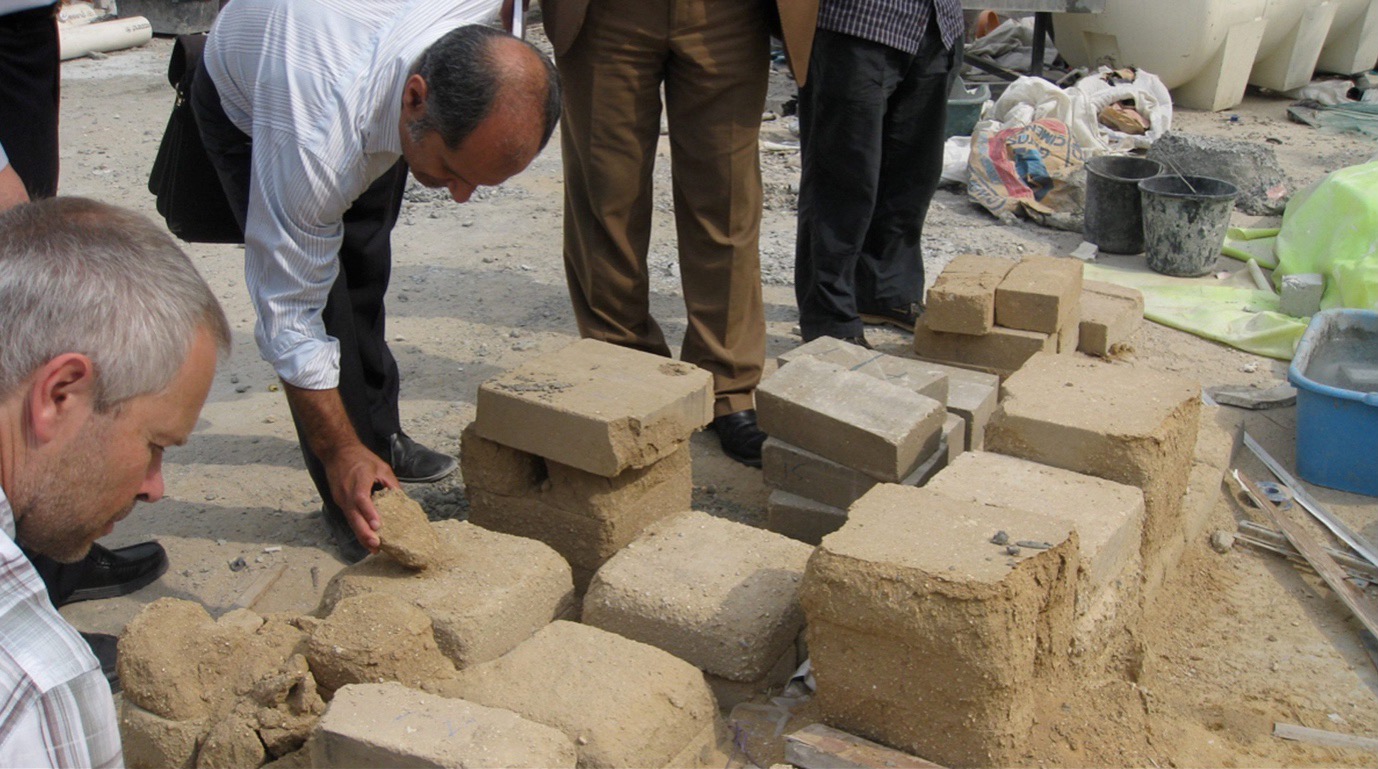
As Israel prevents steel and cement from entering the territory, working with earth has been explored as an alternative. Photo: Yara Sharif, 2010
David Cross: I’m really happy to see you, and I’m very much in your debt for taking the time to speak with me.
Yara Sharif: It’s a pleasure.
Nasser Golzari: It’s wonderful to talk to you. Thank you for sharing those questions. What Architects for Gaza do touches upon most of those questions. So we could give you some background about what we’ve been doing, and the process and structure of our work, and then we could refer to some of the questions.
D. C.: The questions came out of a dialogue between Gene Ray and I, about how art practices and commoning intersect with a planetary view of the social-ecological crisis. Our aim was to explore how different activists, theorists and practitioners combine creativity, criticality and conviviality to build collective agency. But we were both preoccupied with broader geopolitical developments, and over nine months or so, as the global situation became more polarised and dangerous, those lines of enquiry converged. Now we see the two as absolutely connected: the reason why we need to look at the potential of commoning is because common cause is being dismantled, and public discourse is being weaponised.
N. G.: If you don’t mind, we’ll give you a quick background and then move on to some of the questions you’ve asked, which I feel quite close to, and I’d like to expand on. And there are some others that work the other way.
Y. S.: It’s interesting to consider whether the idea of commoning is a Eurocentric concept? Does it also exist within, say, Southwest Asia, but framed in a different way? If it’s more embedded within the everyday, do we relate to it slightly differently? I think that is very much a valid question. Probably a lot of times, our work has had aspects of commoning embedded within it without us being aware of it.
Those questions frame the work we’re doing in a way that makes a lot of sense. Particularly after Gaza, there has been a lot of questions around the role of architecture and architects in a context where erasure and destruction and extractivism of resources has been the main driving force. So we have been asking, okay, what do we do as architects? What do we do before we even start thinking about building? How do we read that landscape from a new perspective? How do we read that space?
A key aspect that was significant for us is the notion of home, and how it is perceived here in the West, versus how it is perceived in Palestine, in particular. In Palestine, the relationship and the role of the collective, the street, the neighbourhood is very strongly embedded within our life; home is not confined to the four walls, it’s not about the individual; home is very much about the collective.
So when we thought about the destruction, and what could we do as architects, it was definitely not just about building homes. But equally, it was very much about challenging these attempts by Jared Kushner and Donald Trump during the war to impose a master plan, as if all these memories and collective practises are insignificant, and the problem can be forgotten. So a concept that developed slowly as we were thinking about Gaza is what we refer to as an ‘architecture of parts’, challenging this notion of the city as a faceless monolith, rather reading it as an assemblage of small pockets where every neighbourhood, every community, every home has its own significance.
And therefore, if any architecture practise needs to step in, probably we need to read the devastated city as parts, and think about connecting this fractured landscape, valuing memory and ruins as a crucial aspect. The first principle—which may sound like a cliché, or a relic of socialist architecture—is to be working with the community. So, we started to work with the local partners in Gaza, asking, what can be done, what can we offer? Architects for Gaza emerged and developed organically to think of ways of helping the community.
We worked on two sites in collaboration and partnership with the local team in Gaza, based on our belief that any architectural intervention or any form of community-driven approach needs to start from within rather than from the outside. Our intervention almost stopped at the point where we felt that rather than imposing our intervention, we needed to give the community a central role. The work was more about reflecting the overall strategy and vision of the partners, now we’re mostly facilitators.
The seed funding has been naturally evolving as a design decision to facilitate space for local architects to further develop design and take central roles in the process of design and decision making.
So we’re working on different levels: on the one hand, rethinking ruins, and what an architecture of parts could be. On the other hand, challenging extractivism, colonial practises and narratives that erase not only the physical space, but also mental space, our space of imagination. We came up with some scenarios of empowerment, because probably in the present moment architecture is less about building, and more about empowering.
N. G.: I can just now start to link some of those points to your question about the prospects for commoning, given the geopolitical movement toward war and whether Karl Marx’s ‘disaster communism’ might emerge from below.
Architects for Gaza emerged in response to the disaster that began with the genocide which started in October 2023. Out of urgency, out of desperation, we just thought, we have to do something as architects. What’s our role? What do we do here? The moment Architects for Gaza was launched, a large group of people from different parts of the world joined in, trying to develop some form of solidarity, but also respond to the disaster, the condition.
In many ways, this commonality was created out of the crisis. It was not necessarily planned, but it was very spontaneous, a dialectical change. When the whole infrastructure is being erased, what is our position as architects?
So we were in this position thinking, what do we do? We’re not politicians, we have to develop our role, we have to use our profession to create an alternative out of the crisis. Then we realised that not only is this an issue of reconstruction, or recovery, or even help to rebuild. Education emerged as a primary issue within the crisis, so we had to create another organisation within this organisation, which was called Gaza Global University, which was set up to enable ownership and stewardship of the local educational structure.
The way it worked out, we reflected afterwards; a system, a framework was created, not because we thought, academically, we should set one up. We simply realised that a large number of students who had no facility to be able to study, wanted to continue or finish their education. They were in Gaza. Most of the teachers were either displaced or… lost, but we were here in London, so we were able to provide support. Although the system, the universities in Gaza were already destroyed, there was an active system in the West Bank. So we linked in volunteers internationally to form Gaza Global University, and already, the common was developed: over 800 academics and practitioners joined in from different parts of the world. We never met them in person, it was a digital group. Next, we said, okay, we are providing education, but how do the students finish? And then, the West Bank universities provided the structure that had been destroyed in Gaza.
We provided the volunteer educators who would see the students, the West Bank universities with the support of the Mediterranean Universities Union (UNIMED) provided the structures, while the certification and the final qualification remained under Gaza Universities. This all came out of discussions, purely through discussions: how do we make sure that the academic infrastructure that has been destroyed would not be erased, but rather empowered? We formed this triangle of Gaza, West Bank, and Gaza Global University, and we started to produce tutorials, lectures, whenever it was possible, and the students qualified. So, this was an outcome from what you might call disaster communism or commonality. And it was all done without a penny being exchanged.
For a year and a half, education was provided. This was not a charity education: the students qualified, with certificates issued by their university, but endorsed based on the existing structure. With the engagement of colleagues around the world, we created a whole new educational system, which does not rely on private ownership, it’s a collective.
The other thing, which Yara mentioned, relates to this question of ecology. We have developed this idea of working with the ruins, of challenging the idea of the blank canvas, as a way of reclaiming the history, marking the time. Also, working with ruins means that you are working with an ecology, a landscape—not only the physical landscape but also the cultural landscape, the neighbourhood, the streets. One of the workshops we ran with displaced Gazans was called, ‘Right to Street, Home and Neighbourhood’, which is critical to challenge the capitalist drive towards ‘cleansing’.
Y. S.: Whenever we talk about ecology we talk about going beyond humans, challenging extractivism… In Europe when climate or energy are discussed, it often comes from a position of comfort or even luxury, and becomes reduced to technical calculations of carbon emissions, or abstract framings of biodiversity. In a war zone like Palestine, ecological breakdown is urgent—dealing with it is an emergency practice to survive. It is our culture and landscape. Sadly, settler-colonialism is about land grab and extraction of resources, in some areas it does everything possible to destroy the land in order to occupy it. That’s why it was important to us to honour the ruins, and treat it with care. Even if it appears as a dead landscape, in fact it holds a lot, the artefact of home, the memory and the human bodies that have been left under the rubble. And we can’t speak about Gaza without thinking about the sea, the fish, the migrating birds. Gaza is on one of the most important bird migration routes in the world.
The impact of the bombs includes ecological damage and destruction: toxins in the air, asbestos particles from roofs falling on refugee camps, sewage and water contamination… A coherent environment has been destroyed by the culture of extraction and grabbing. Sadly, climate activists aren’t dealing with Gaza with a similar urgency as they do with pollution on Marylebone High Street! The duality is almost a form of hypocrisy. For God’s sake—when are they going to deal with Gaza as a climate and ecological crisis?
D. C.: For years, I approached the climate and ecological crisis as a white, male English environmentalist, wanting to preserve a healthy environment. But as I’ve learned more, I’ve come to see that the crisis is the product of imperialism, much of it British and now North American imperialism, which combines racial capitalism with extractivism and ecocidal tendencies. In Gaza, the staggering devastation that has been so cruelly inflicted is at once a physical, cultural and psychological phenomenon. Each aspect of the situation is an intersection of factors, spanning many domains. How might an architect approach this crisis differently from, say, an aid worker, a journalist, or an artist?
Y. S.: We’re dealing with an extreme scenario in Gaza, where the pollution is at so many different levels, and the destruction of the ecology is impacting social practices because our culture as Palestinians relates to the land. It’s a very seasonal practice: we hibernate when the birds hibernate, we set our houses against the wind, against the aggression of the sea, we use the roofs as summer rooms. Everything is related to nature and climate.
One difficult notion to deal with in such context, is the idea of repair and how to deal with ruins. If ruins are the graveyards and the memory of the place as well as the remnants of home, how to define repair? We needed to pause and think about how to protect these ruins and the memories they hold as markers of time that cannot be divided from the physical architectural reconstruction. There is a danger in seeing repair as an end outcome which is that it could erase this spacio-cide[note]See Sari Hanafi, ‘Explaining Spacio-cide in the Palestinian Territory: Colonization, Separation, and State of Exception,’ Current Sociology, vol. 61, No. 2, 2012, https://doi.org/10.1177/001139211245[/note] in Palestine, particularly in Gaza. Therefore, in this case repair needs to acknowledge and mark history, it is an ongoing process to heal, hold, mark and stitch.
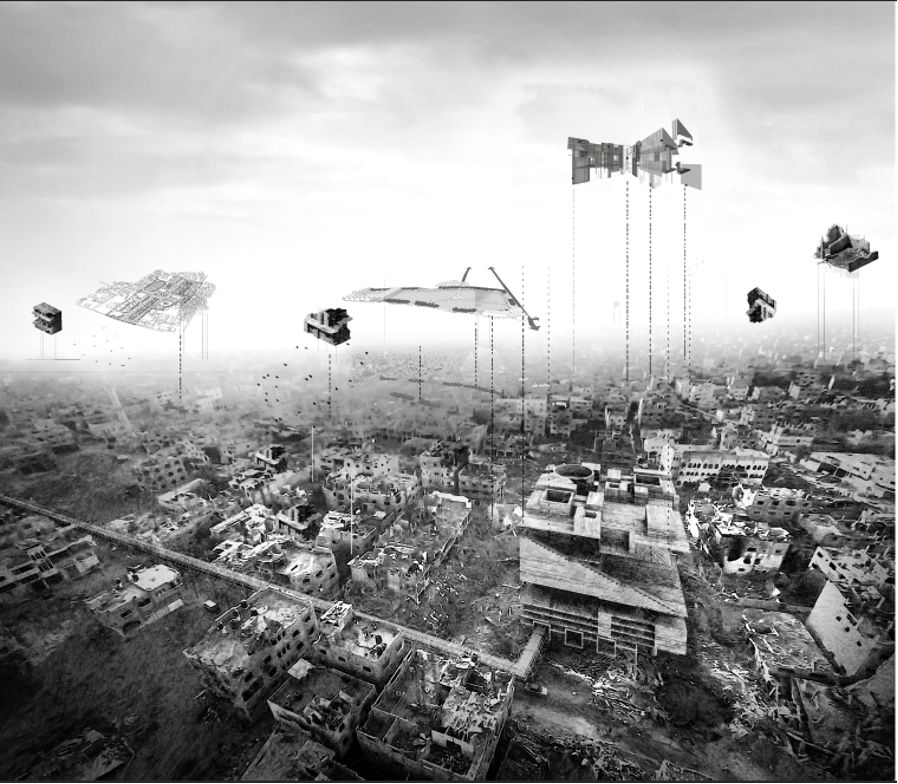
An Architecture of Parts. Image: Architects for Gaza, 2024
N. G.: The critical role of architects which we have been learning since setting up Architects for Gaza is understanding what the process should be and who should be involved. A key issue concerns what comes from outside and what needs to come from inside. Not collaborating for the sake of the word, but actually working with the people who live in that landscape and responding to their needs and urgencies and aspirations. So forgetting about forms, (often, journalists want to know what forms we are proposing) this is actually about process: who you work with, how much you facilitate and let go of ownership and control.
Y. S.: How much you redistribute agency as well; it’s very supportive.
N. G.: So this collaborative participatory work is not just for the sake of it being participatory design as in the language of the academic world. We realised that things cannot be run from outside, it has to be given to the inside. So working with the ruin is important, but also making sure that the informal daily practices are embedded, the footprints of the streets and neighbourhoods are maintained, because the street that was there, that coffee shop, that tea house, that ice cream shop are part of the everyday memory.
Y. S.: Architecture here is not about the buildings, it’s about redistributing the agency and holding onto that moment of time, and finding ways to mark it. We still don’t know exactly how to do it.
N. G.: For that reason we developed this concept of an Architecture of Parts. This did not come predetermined: we realised it through responding to the local partners who were calling on our support during the two and a half years. They had already through this crisis developed their own solidarity, their own commons to continue life, ownership and agency. They developed this amazing structure and framework. The only way we could do anything was to work with them, which is how we came up with the focus on ruins and footprints.
The other thing that we’ve been under a lot of pressure with has been addressing people’s immediate need for shelter. There’s been a lot of discussion about that, but of course our role has got to be at times technical, at times urbanist, at times just purely facilitator. Because they have a lot of knowledge locally, we have to be careful about how much we impose and how much we come up with the idea for doing something. That process of setting up a framework as a collaborative act is the only way that something can be built, can be done in which ownership is taken by locals.
D. C.: So the reconstruction process entails an obligation to redistribute agency, to renounce some of that famous control that architects are so respected for, and to hand it back to the people, the communities that you’re working with. Then there is this question of the plot, as an officially registered piece of land. In terms of the urban form, the military occupation and genocidal onslaught seek to obliterate both the buildings and the system of plots. But beneath the rubble the pattern of streets and plots of public and private buildings and common spaces remains. Despite the Israelis’ attempts to erase the urban memory, it still exists: even if the people are gone, there are relatives, neighbours, and fellow citizens that can combine their recollections as a form of common knowledge. Are there also municipal documents that you can begin with to re-establish that this territory exists?
N. G.: Absolutely. The municipalities of Gaza have been instrumental in shaping and sustaining the city, often working under exceptionally difficult circumstances. Their active role in building urban infrastructure, delivering essential services, and supporting community resilience has been vital to the city's development. Similarly, the ministry of housing has been working on emergency repairs. Records of land ownership exist, structures exist. The problem is the siege and the spacio-cide. Gaza’s municipalities have long been known for their ambition, effective administration, and commitment to the city’s development. As early as 1893, revenues generated from barley cultivation were reinvested in public infrastructure and civic projects. These funds helped finance hospitals, municipal buildings, and plans for a maritime pier, reflecting a longstanding tradition of directing local resources toward improving the city and enhancing public life.
The respect given to private ownership is fundamental in the works going on. When we were working with local partners on the different sites, they tell you very clearly, ‘that drainage line cannot go that far because the land is under the ownership of someone else’. This is not an empty land. The discussion is socially and culturally conscious with a strong awareness of how space is used and experienced within the community, emphasizing the need for designs that respond to local social and cultural aspirations, land value and ownership respect. At one point, they noted, ‘That place is our garage; this part should be allocated for the women’, highlighting the importance of considering everyday practices, community values, and cultural needs in the design process.
Y. S.: Those kinds of division, that respect of land ownership, even without paperwork, has always been part and parcel of that culture and life. We must remember that Gaza is 5000 years of history. The structure or fabric of the city— the varying density, the market, the street, the neighbourhood—is very much honoured. And of course, we have the famous spine of every city in Palestine, and probably everywhere else in the Global South. Very important roads, the port, I mean.
If there is anywhere in the world to learn the concept of common from, it’s probably the Global South. In Palestine when the olive harvest starts, people might say, ‘up to that tree, that’s mine. The next tree is yours’; despite the informality, there is a sense of respect and collective agreement. People know that when we do the olive picking season, we can’t go and pick our olives tomorrow, we have to wait till everybody’s there as a collective practice of sharing and respect. These practices continue until today.
Despite the clear boundaries of private and public use, the recent events with the need for emergency shelters blurred these boundaries slightly. One of the public sites we’re working with is the old football stadium owned by the municipality for public use. But now due to Israel’s military operation, the stadium is used as an emergency shelter. All the tents are there. Of course, the municipality respects that and accommodates it in their practice as an urgent measure.
Beyond individual interests, the collective takes far more importance.
N. G.: And the important thing, as we collectively develop the concept vision of these sites there is an immediate, short-term and long-term plan, structured into three or four phases.
And then, because this has been developed with local partners over a year and a half now, when they go out to consult others, in between the ruins and rubble, they emphasize the importance of long-term vision said, this is our dream and vision. This is the municipality and Palestinian housing council’s dream of developing at different stages and learning from previous experiences.
The nature of questions, discussion and dialogue during public consultation is rich and full of engagement and commitment. Like, ‘how does the drainage work in here? How to maximise grey water filtration, rainwater collection? Do we need this? Should we do that? And should we have the clinic here because we already have another one in this side… this is an important road for the city… very valuable land.’ So the questions asked are very practical, but also quite speculative and dreamy, which is hopeful. In summary, they still own that place, regardless of what Trump and the others think, it is their home.
D. C.: This is very heartening to hear!
N. G.: It is. The people of Gaza want to speed up, they want to build things—they’ve already got two different sponsors for clinics. The challenge is the continuous siege, the intentional destruction of infrastructure, the scarcity of materials. Despite that, the local partner is thinking very strategically, ‘we need an artificial limb centre because we’ve got a lot of people in urgent need’ So we’re working with very immediate practical needs, but yet also long term.
D. C.: When the reconstruction plan is structured in terms of phases, the urgent, immediate need for safety and shelter is followed by the longer-term project of rebuilding the collective awareness of the form of the neighbourhood, and ultimately a more imaginary horizon of what might be possible in the future.
When the plan to rebuild is structured in terms of physical scale, architectural practice might operate at the scale of a single plot of land, upwards to a neighbourhood or a whole urban settlement and beyond to infrastructure. Given the scale of the devastation inflicted on Gaza, the challenge of rebuilding what was destroyed is already vast. But are we now into a different state of the world? As dependency on fossil fuels has driven the climate crisis, and contributed to escalating regional wars, do you think this could be an opportunity to rethink how the urban environment relates to the landscape and climate? If so, do you think that is in the realm of the public, or could it extend also to the commons?
Y. S.: The urban environment needs to respond to the climate crisis with less dependency on fuels. Equally, thinking of collective means of living beyond the obsession of private ownership is needed everywhere. Ironically, Gaza is known to be rich in gas and natural resources. This is exactly why it is being occupied, to control and extract its resources.
N. G.: Phasing is the way it’s worked out. It is a purely practical method working with available materials and resources to address urgency and scarcity; challenging siege, extractivism, and capitalist greed is embedded as a tool for survival, yet it has opened a way of looking to the future.
Again, the phasing approach came about through discussions with the local community and the local partners. Environmental awareness is part and parcel of the community’s need to survive. The culture of waste does not exist, because nothing can be wasted in a state of scarcity.
Gazans are very much interested in doing things differently, more efficiently and creatively. For example, one of the sites that we’re looking at is an old reservoir. It was bombed very early on because that’s where the water is. They also bombed the drainage system that went into the cleaner water, so the whole water system was contaminated for a year and a half.
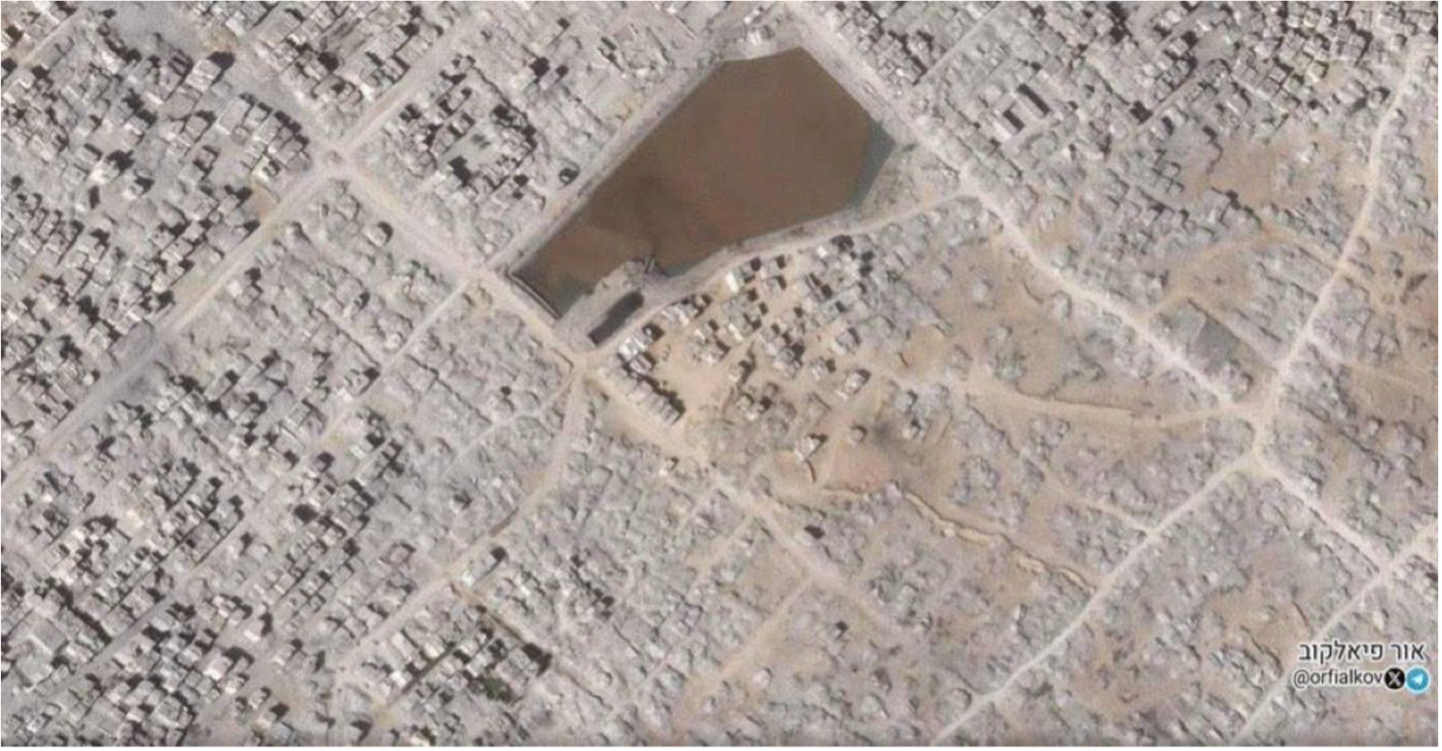
Satellite view showing the destruction around the Sheikh Radwan reservoir site. Courtesy of the Municipality of Gaza
In partnership with the local experts, strategies were developed of dealing with some of the immediate problems. Now, one of the intentions is to rebuild that reservoir, but with other things around it to heal and nourish the neighbourhood, the streets and celebrate the water as an element of life rather than disaster.
D. C.: Lovely!
N. G.: Yeah, so the market would be around it, alongside other functions which would enhance the way of living and help the infrastructure.
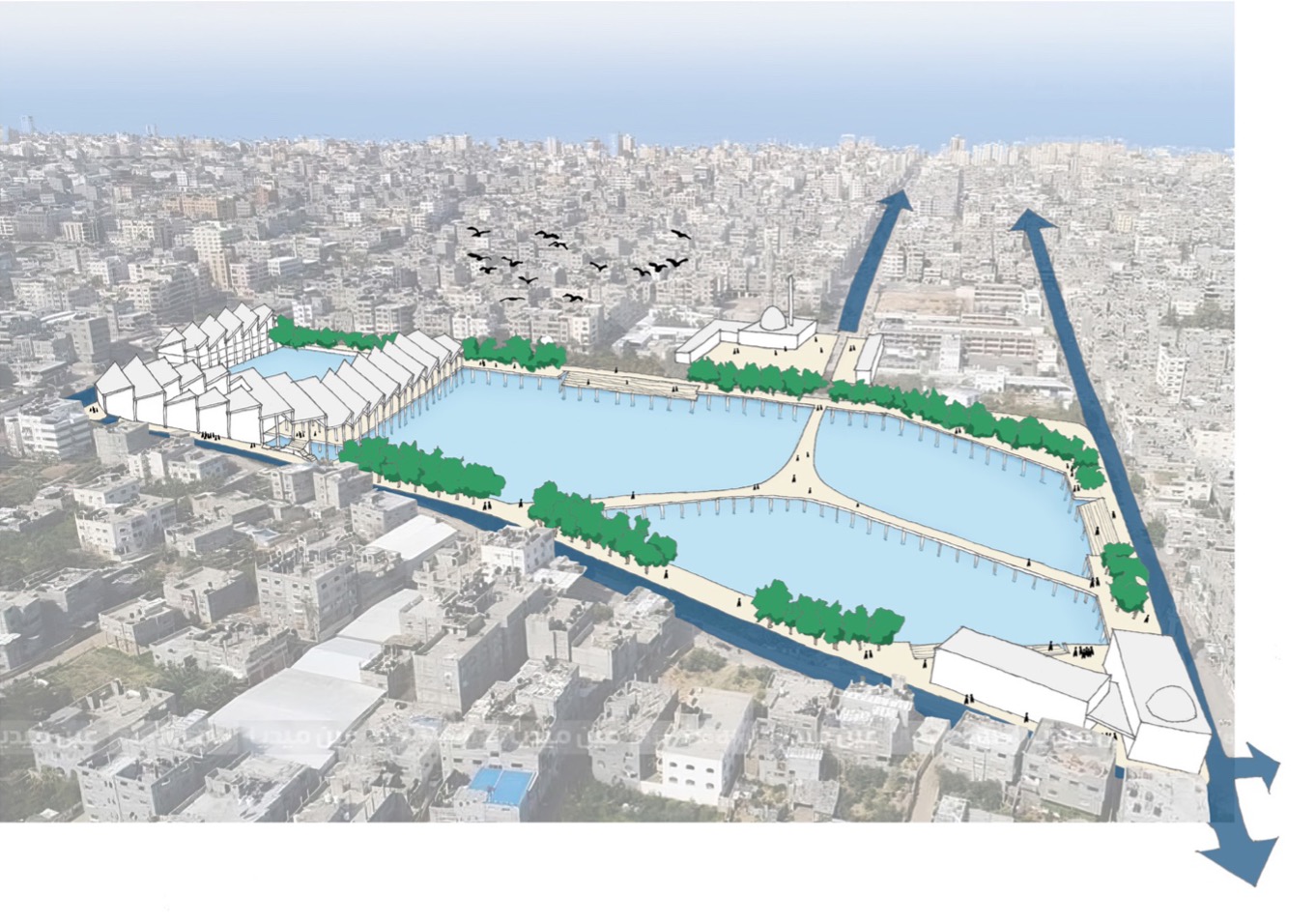
Architects for Gaza, Proposal for the redevelopment of Sheikh Radwan Reservoir, 2025.
The interventions are carefully done. It’s not just, ‘let’s clear it and build a new, ideal city’. Neither is it, ‘let’s just keep everything as it was’. It’s an informed way of practising that builds on years of experience and knowledge in Gaza, by Gazans on what could work and what may not work.
D. C.: We’ve all been struck by these horrific AI-assisted visualisations that Jared Kushner and his cronies have been pushing. The breathtaking insult, the audacity, and the nihilism of those images have taken many people, including me, by surprise. Those property developer visualisations, and the related plans for zoning Gaza have been spread around the world by the imperialist media. Could a global commons assist in the dissemination of the counter vision? Is there a network of people who can help spread the vision that you’re helping to realise?
Y. S.: There is real power in collective solidarity. In this case, it’s not a clear-cut activism, it’s also through spatial practice. In essence, the counter vision is the vision of the local residents of Gaza. We have a responsibility as practitioners, whether as architects or artists or social scientists, to amplify the local voice and preserve it, whether it’s through storytelling, through a written piece, through maps. That is happening, but it’s important to collectively get together in order to share that and enable it to be amplified. And we can name it whatever we want to name it. But we must challenge this imagery from Kushner and others because it is intended to destroy that mental image that we were familiar with.
N. G.: Equally, we are not individuals acting on our own, we represent a whole collective of people—academics, intellectuals, activists from Gaza, Palestine and beyond—who resist these colonial schemes. Somehow we need to develop a platform where the vision, developed by and with the Gazans on the ground, can be shared.
D. C.: I’d be interested to hear your thoughts on the scale of a potential commons. At one end of a spectrum is the undifferentiated mass of humanity, maybe as expressed in the Universal Declaration of Human Rights. At the other end is the isolated, atomised individual subject under capitalism, in which everyone is separated from everyone else, expressing their identity through their patterns of consumption. Neither of those is an acceptable template for the building of a commons. But if a city of parts, as you’ve described, consists of neighbourhoods or small communities, how many people, what sort of scale can a neighbourhood increase to, while remaining a viable community of people? Is there a certain scale at which, rather than expanding the neighbourhood further, a community would be like a hive of bees, which detaches and moves off to form a distinct community that coexists with the first one?
Is there a number of people, or a unit of area such as a dunam or a hectare? Is there any scale or spatial limit to a viable community before it should become a separate entity?
Y. S.: The idea of collective sharing, community and the power of neighbourhoods and streets as an extension of home is not new to Palestine with its social and cultural practices. Traditionally historic centres had a guest house/room that was high enough to accommodate any guest arriving to the village – as a community. Under colonisation, commons started to emerge organically as individuals, later consciously as a collective practice and as a form of spatial resistance. When Israel started to extract resources, and to use mobility as a tool to disconnect people from one another, local initiatives started to be born and solidarity practises started to emerge from the home, and these expanded to become the neighbourhood. The home became the school, and the market became mobile. If you have two loaves of bread, you pass one to your neighbour. If the street is jammed with traffic due to checkpoints, community steps in to ease it like the case of Qalandya checkpoint.[note]See Rema Hammami, ‘On the Importance of Thugs: The Moral Economy of a Checkpoint,’ Institute for Palestine Studies, 2005, https://doi.org/10.70190/jq.I22.p16[/note]
So everybody was collectively in solidarity, the city was working together without us even knowing it, and then the village became that source of resources. In order to nourish that common, you have to be self-sufficient, you have to make sure that you have your right to resources.
When Israel realised that, they started to extract those resources that create self-sufficiency, they started to ban people from the right to resources. During that period, Israel changed the colonial strategy. Raising chickens or sheep, or even a cow, became a danger. In response, they steal and kidnap the cows? The famous The Wanted 18 film[note]The Wanted 18 (2014) is an animated documentary directed by Amer Shomali and Paul Cowan.[/note] is all about them chasing 18 cows in a village in the West Bank.
Because people were producing, they were able to be self-sufficient. So that started from a village, then expanded to the city, then to whole cities—including Gaza— and then other countries started to learn from it. So if the idea is put into practice, it can expand everywhere as long as there is a consciousness of defying that culture of privatisation, extraction and exploitation.
Because we know also that our freedom is very much related to the right to our resources, the right to materials, the right to clean water, to the basics. Before we get those basics in hand, we’re not able to think creatively.
Maybe this is the danger of that sense of collectivity being lost, sadly, in the context of Palestine and the world as a whole. With the arrival of the ‘free market’ economy, with the extraction of resources, people slowly started to shift away from thinking collectively, to thinking individually: ‘I no longer care about my neighbour, I care about myself, my sense of security given the uncertainties’.
N. G.: This is quite critical. While working in Palestine since 2007, one of the objectives was to stitch the fragmented landscape together. Learning that stitching the landscape to assure it is no longer fragmented, means that people can rely on each other’s economy. A key technique in Israel’s occupying process is restricting mobility to break communities through isolation. Checkpoint, checkpoint, checkpoint, until you just completely disconnect into silos which become isolated and shrink.
While working on the 50 Villages project in partnership with RIWAQ[note]RIWAQ is a centre for the preservation of architectural heritage of rural Palestine. See www.riwaq.org.[/note], the brief was to bring life back into the historic centres. Connection was also about creating economic belts/corridors and breaking the spatial isolation.
Y. S.: These economic corridors would allow that stitching to happen in Gaza and across Palestine as a whole. So, on one hand, empowering the locals with resources, empowering them to not feel isolated, physically, and mentally, and also economically by creating corridors where everybody can self-rely and rely on one another. So it’s an overall comprehensive system.
D. C.: Beyond a general ideal of solidarity, do you see potential for concretely building common cause between your work and other struggles around the world?
N. G.: Yes, of course, this spatial engagement comprising the city of parts and the method of ‘stitching’ applies to so many different places that we’ve been to, and worked in.
We don’t see this as the blueprint, but a strategy for places where communities are living under occupation, colonial exploitation of resources, and injustice. These are critical issues that we want to look into.
The method of connecting, to make sure that neighbourhoods are not fragmented, demands recognition that the ‘hard assets’ of buildings and infrastructure are inseparable from the ‘soft asset’—the people. Also acknowledging the role of the street as an extension of the collective home.
D. C.: That’s a vivid, positive image. Conventionally, the street is often represented as a kind of negative space or void between the architectural forms of the city. But the street is the vital counterpart, and the people are what brings life to the ‘hard asset’ of the physical structures, the property.
Y. S.: What we learned from Gaza is that the street is the extended living room, the extended neighbourhood. Even in a literal sense, people put a TV and a sofa in the parking lot, and the whole community is sitting watching TV together rather than watching it on their own.
Now it’s an amazing time of the month—it’s Ramadan. If you want to learn about the power of the common, just walk in the streets of any city that fasts, like Cairo, Damascus, or Tehran. The whole concept of a collective cooking is that no one should be hungry in their own home; people feed one another. It’s the power of everyday rituals, small practises. The grandma might not describe these in terms of feminism or commoning, but when she cooks, she cooks for a community, because she knows somebody may knock at the door. Or she knows that food will not be wasted because she can send it to somebody else who’s in need. We try to bring that in here, as a conscious practice. So when we look beyond the general idea of solidarity, towards building common cause with others struggling in the world, let’s remember that the struggle is also here in London and the UK, where poverty is high, and exploitation of people and resources is extreme.
If anything, we need to learn from Gaza and the Global South. How much can we apply those insights in Western Europe or in the West generally? We in the West tend to turn a blind eye and we are seeing comfort with a completely different perspective that really needs to be broken.
One of the places to learn from is Cuba, with its idea of a collective living, and alternative vision to what a street and a neighbourhood mean.
D. C.: I joined the demonstration on Saturday where people were shouting out about the belly of the beast.[note]‘From the belly of the Beast, hands off the Middle East!’ slogan chanted by demonstrators in London against US-Israel war on Iran, Saturday 7 March 2026.[/note] London is a place of insatiable hunger, a rapacious greed for resources, which devours everything, but is ultimately hollow, and not sustaining. In contrast, this vision you’ve shared of people eating collectively in the street, joining neighbours, connecting together through mutual sustenance is so fulfilling.
N. G.: The crisis of capitalism has taken away people’s strength, hence we need to bring back the collective. This is what gives us hope.