![[missing img]](/issue/sites/head_issue/files/image/couverture1.jpg "/issue/sites/head_issue/files/image/couverture1.jpg")
![[missing img]](/issue/sites/head_issue/files/image/Capture-d-ecran-2026-10-07-a-15.47.01.png "/issue/sites/head_issue/files/image/Capture-d-ecran-2026-10-07-a-15.47.01.png")
Élise Domenach: Where did this book come from, both in practical and intellectual terms? What inspired you to publish a book on this filmmaker who had until then been somewhat ‘overlooked’ by French-speaking academic research?
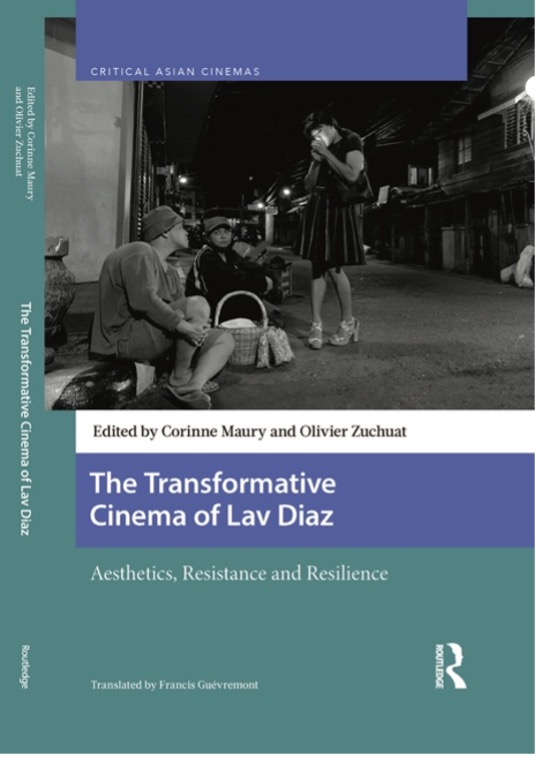
Corinne Maury and Olivier Zuchuat: In 2019, one of us (Olivier Zuchuat), a professor in the Cinema Department at HEAD – Genève, planned to organise a filmmaking workshop in the Philippines for second-year students under the guidance of Lav Diaz. To prepare for this project, we (Corinne Maury, Marcos Uzal and Olivier Zuchuat) organised an international symposium entitled ‘Lav Diaz: faire face’ in Geneva. The book Lav Diaz: Faire face was published in French in 2021 by Post-éditions and is a continuation of this initiative. Its English translation by Francis Guèvremont was published in March 2026 by Routledge as part of the “Critical Asian Cinema” series under the title The Transformative Cinema of Lav Diaz: Aesthetics, Resistance and Resilience.
E. D.: In France, the retrospective of Lav Diaz’s work at the Jeu de Paume museum in 2015 marked a turning point in the recognition of his work. Did it play a part in the conception of this book? Until then, only film critics (Vertigo, Positif and others) and programmers (including Marie-Pierre Macia, who played a decisive role in screening his films at the Cinéma du Réel festival in Paris, as well as Federico Rossin) had taken an interest in this very unique work. Did you consider involving film critics and programmers of Lav Diaz’s cinema in the development of this book?
C. M. and O. Z.: The symposium program was structured around aesthetic and historical issues that we considered important based on our understanding of Lav Diaz’s work. We then contacted researchers and critics whom we knew and who, judging by their previous work, we believed could make an interesting contribution to the aesthetic and political analysis of Lav Diaz’s work along these research lines. In agreement with Lav, we set up an online video library containing all his films, which served as a working resource and enabled some of these researchers and critics to discover aspects of Lav Diaz’s work with which they were previously unfamiliar. We have also included in the book a lengthy interview with Lav Diaz by Alexandero Tioseco, originally published in French in connection with the screening of the film Death in the Land of Encantos (2007) at the Cinéma du Réel festival in 2008.
E. D.: The book chooses not to categorise Lav Diaz’s work according to the usual distinctions between documentary and fiction, or between historical and contemporary films. Why is that?
C. M. and O. Z.: The conference and the book are structured around several research themes, which correspond to the book’s four parts: the question of history and decolonialism (“1. Violence Stories, Resurgent History”); the issue of space and the related issue of climatic and seismic disasters that regularly devastate the archipelago (“2. Devastated Land, Ritualised Land”), the violence and abuses (political, military, sexual) endured by the population (“3. Wounds”), and finally an analysis of the creative processes underlying Lav Diaz’s cinema (“4. Gestures of Creation”). This structure breaks free from the documentary/fiction dichotomy, which we considered imperative. A film such as Death in the Land of Encantos indeed interweaves ‘documentary’ sequences shot at the base of the Mayon volcano with the survivors in the wake of the typhoon, and purely fictionalised sections shot in situ amidst the ruins, a few weeks after the disaster. Thus, Death in the Land of Encantos defies any attempt to categorise it dichotomously as either documentary or fiction.
![[missing img]](/issue/sites/head_issue/files/image/fig1a.png "/issue/sites/head_issue/files/image/fig1a.png")
Death in the Land of Encantos (2007)
![[missing img]](/issue/sites/head_issue/files/image/fig1ba.png "/issue/sites/head_issue/files/image/fig1ba.png")
Death in the Land of Encantos (2007)
E. D.: Hazel Orencio, an actress and assistant director to Lav Diaz – and occasionally an executive producer – plays a significant role in the book. Why?
C. M. and O. Z.: Lav Diaz works with a close-knit group of actors and technicians. We felt it was important for the key figures in this group to be featured in the book. Hazel Orencio is one of the pillars of the film production team in her role as assistant and has been one of the leading actresses in Lav Diaz’s films for over 15 years. Her presence at the conference "Lav Diaz: Faire" face seemed essential to us. Her contributions, some of which appear in the book as transcripts of the masterclass she gave with Lav Diaz at HEAD in October 2019, help to shed light on Lav Diaz’s distinctive methods of directing actors. We continued this work by conducting interviews in the Philippines during the 2020 shoot of the film Essential Stories of the Lake (2023), notably with director of photography Larry Manda and the actors John Loyd Cruz and Charo Santos.
![[missing img]](/issue/sites/head_issue/files/image/fig2.jpg "/issue/sites/head_issue/files/image/fig2.jpg")
Hazel Orencio dans Berceuse pour un sombre mystère (Hele Sa Hiwagang Hapis, 2016)
E. D.: What does the idea of incorporating ‘creative gestures’ into an analysis of Lav Diaz’s cinema mean?
C. M. and O. Z.: Lav Diaz’s production, filming and editing techniques are highly distinctive. They have a direct influence on the aesthetics of his films, and vice versa: his aesthetic choices – notably his use of enduring fixed shots, which we have termed ‘situation shots’ – require specific creative processes that we have sought to analyse. Consequently, one of us travelled to the Philippines whilst the film Essential Stories of the Lake was being shot. During filming, Lav Diaz would write new elements of the screenplay every night, drawing on the encounters he had in the village.
![[missing img]](/issue/sites/head_issue/files/image/fig3a.jpg "/issue/sites/head_issue/files/image/fig3a.jpg")
Tournage en 2020 de Essentials Stories of the Lake (2023). Photographie : Olivier Zuchuat
![[missing img]](/issue/sites/head_issue/files/image/fig3b.jpg "/issue/sites/head_issue/files/image/fig3b.jpg")
Tournage en 2020 de Essentials Stories of the Lake (2023). Photographie : Olivier Zuchuat
![[missing img]](/issue/sites/head_issue/files/image/fig3c.jpg "/issue/sites/head_issue/files/image/fig3c.jpg")
Tournage en 2020 de Essentials Stories of the Lake (2023). Photographie : Olivier Zuchuat
![[missing img]](/issue/sites/head_issue/files/image/fig3d.jpg "/issue/sites/head_issue/files/image/fig3d.jpg")
Tournage en 2020 de Essentials Stories of the Lake (2023). Photographie : Olivier Zuchuat
Observing the shooting also provided an insight into how Lav Diaz asks the actors to inhabit a predefined, fixed frame, which they familiarise themselves with by looking through the viewfinder before performing. Most scenes are then filmed in a single take, regardless of whether a dog walks through the frame, a chicken stops within it, or sudden gusts of wind kick up a cloud of dust.
E. D.: There are a great many illustrations in the French edition of the book. What principles guided the choice of illustrations for the book?
C. M. and O. Z.: Lav Diaz has provided us with numerous master files of his films. Composition guidelines were established in collaboration with editor Sébastien Raimondi and graphic designer Pierre Seydoux: to compose series of photographs that capture the evolution over time of Lav Diaz’s situational shots; to include full-page images at the start of each section, making the most of the HD or 4K resolution of the footage; to create collages of stills where necessary, particularly to visualise on paper the territorial archipelagos that structure Lav Diaz’s editing.
![[missing img]](/issue/sites/head_issue/files/image/fig4.jpg "/issue/sites/head_issue/files/image/fig4.jpg")
From What Is Before (2013)
The English version, published by an academic press (Routledge), was limited in the number of images it could include, so some difficult choices had to be made.
E. D.: Four years after the book’s original publication, this English translation breathes new life into the work and opens up new horizons for its reception. How do you assess the evolution of Lav Diaz’s work and its reception since 2022?
C. M. and O. Z.: One of the major changes that has taken place since 2020 concerns the distribution of Lav Diaz’s films, particularly in the Philippines, where they are regularly screened in cinemas. Lav Diaz’s films now enjoy widespread recognition in his home country. The film Magellan (2025), which features the Mexican actor Gael García Bernal in the cast, may well mark a new turning point, a new phase: a larger budget, colour cinematography (courtesy of cinematographers Larry Manda and Arthur Tort, who has worked with Albert Serra, among others – Serra himself being a co-producer of the film) and a relatively short running time in the final cut (2 hours 40 minutes). True to form, however, Lav Diaz shot the film using a Panasonic Lumix GH7 camera in 4:3 aspect ratio and has produced an extended version – a director’s cut – lasting over 9 hours, in black and white, which may one day be released.